
The LLM Model Map (2026): Providers, Top Models, and How Sitekick Uses the Best of Each
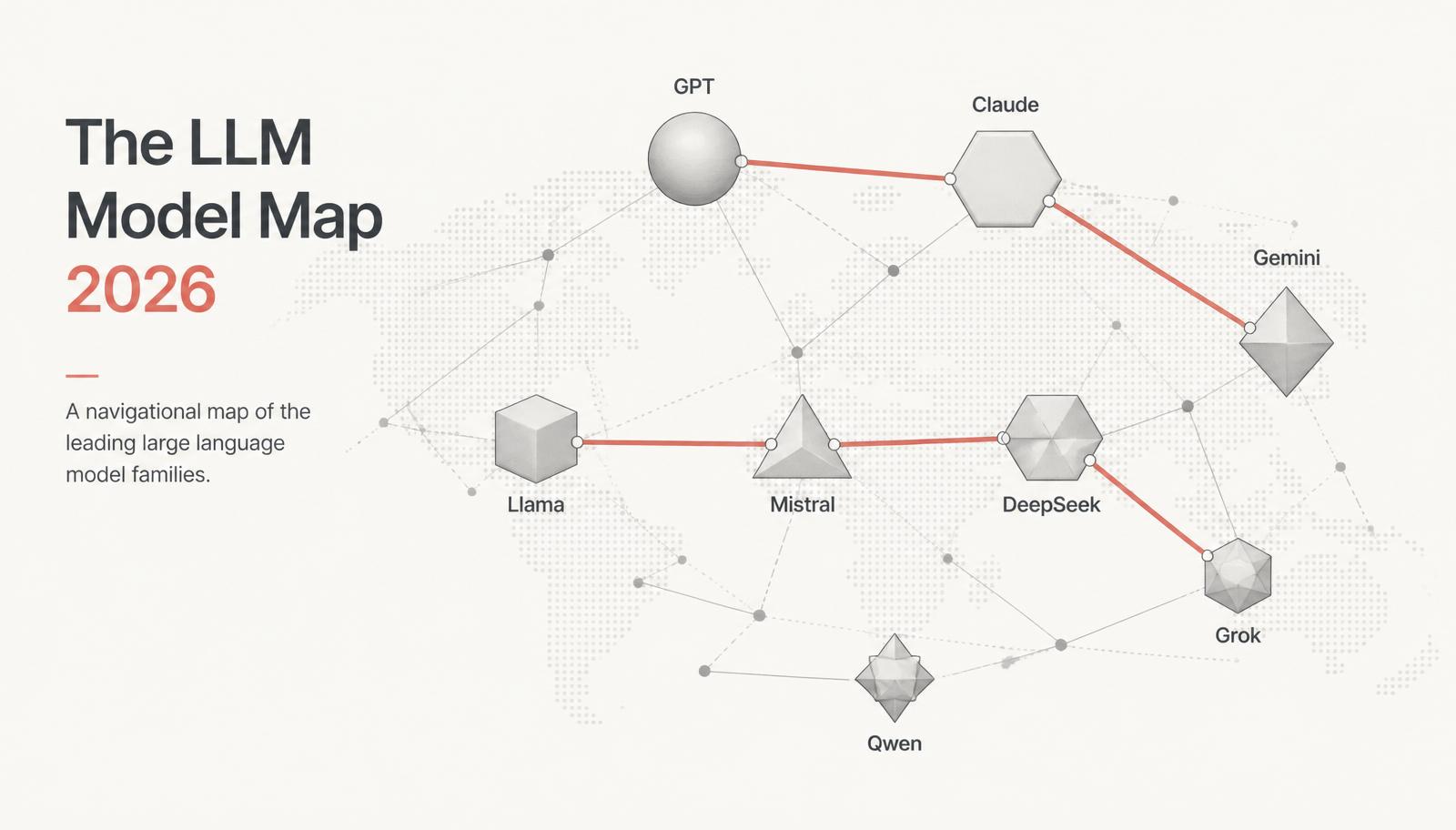
TL;DR — There is no single "best" LLM. There are best‑for models: reasoning, coding, long context, multimodal, safety, cost. The winning move is routing — sending each task to the model that is strongest at that job. That is exactly how Sitekick turns real‑world changes into tasks: the right model for summarizing, the right model for deciding, the right model for drafting the next step.
The uncomfortable truth: "best LLM" is a trick question
Everyone keeps asking the same thing.
- "Which model is the best?"
- "Should I use GPT‑5, Claude 4.5 Sonnet, or Gemini 2.5 Pro?"
- "Is Llama 4 better than Mistral Large?"
- "Do I need o3 or is DeepSeek V3 enough?"
But that is like asking "which vehicle is the best?" A Formula 1 car wins on a track. A pickup truck wins hauling gravel. A scooter wins in Bangkok traffic. LLMs are the same. Ask "best for what?" and the map suddenly makes sense.
The 2026 provider map (the names you actually need to know)
Here is the current landscape at a glance — every family Sitekick can route to today.
1. OpenAI — GPT‑5, o‑series, GPT‑5 mini
The category leader for general reasoning + tool use. GPT‑5 is the workhorse for polished writing, structured output, and agent‑style tool calling. The o‑series (o3, o4‑mini) are the "thinking" siblings — they trade latency for step‑by‑step reasoning on math, planning, and multi‑hop research. GPT‑5 mini and GPT‑5 nano cover high‑volume, low‑latency work.
- Best for: balanced reasoning, function calling, agentic loops, mainstream product surfaces
- Watch out: premium tier can be expensive at scale — route only the hard tasks here
2. Anthropic — Claude 4.5 Sonnet, Claude 4.5 Opus, Claude Haiku
Claude is the model developers reach for when they want long, careful, safe writing and serious coding. Claude 4.5 Sonnet has become a favorite for code generation, refactors, and reading giant repos. Opus is the heavyweight for hard reasoning. Haiku is fast and cheap for classification and simple summarization.
- Best for: coding, long documents, careful reasoning, "please don't hallucinate" workloads
- Watch out: occasionally over‑cautious — you sometimes need to prompt around refusals
3. Google DeepMind — Gemini 2.5 Pro, Gemini 3.1 Flash, Gemini Nano
Google's edge is multimodal + huge context windows. Gemini 2.5 Pro handles PDFs, screenshots, video frames, and million‑token contexts without breaking a sweat. Gemini 3.1 Flash (and its "Nano Banana" image sibling) is the fast, cheap option for high‑volume chat, extraction, and image generation. Gemini Nano runs on‑device.
- Best for: long context, vision, cross‑modal reasoning, cheap high‑volume workloads
- Watch out: style is more literal — Claude often reads more naturally for prose
4. Meta — Llama 4 (Scout, Maverick, Behemoth)
Meta's Llama 4 family is the flagship of open‑weights. It ships in flavors: Scout for edge/on‑prem, Maverick for balanced serving, Behemoth for frontier‑class research. If you need to run models on your own infra, comply with data‑residency rules, or fine‑tune deeply, this is where you start.
- Best for: self‑hosting, fine‑tuning, data‑sensitive enterprises, edge inference
- Watch out: you own the ops burden — GPUs, evals, safety layers
5. Mistral — Mistral Large 2, Mixtral, Codestral
Mistral is Europe's answer, prized for efficient MoE architectures. Mistral Large 2 is a strong general model, Mixtral is the classic sparse‑MoE workhorse, and Codestral is a coding specialist. Great when you want European hosting, competitive quality, and a lighter footprint.
- Best for: cost‑efficient serving, code tasks, EU data residency
- Watch out: smaller ecosystem than the US giants — fewer eval leaderboards, fewer fine‑tunes
6. xAI — Grok 3, Grok Mini
Grok 3 from xAI is optimized for real‑time information (via its integration with X) and unfiltered reasoning. It's a good pick when the freshness of an answer matters more than the polish.
- Best for: current events, sarcastic/creative tone, "less filtered" answers
- Watch out: newer safety/eval ecosystem — worth verifying outputs on sensitive topics
7. DeepSeek — DeepSeek V3, DeepSeek R1
DeepSeek shook the industry in 2025 by proving frontier‑level reasoning can be trained at a fraction of the cost. R1 is a "thinking" model comparable to o‑series on math and code, and V3 is a strong general chat model. Open weights, extremely competitive on price/performance.
- Best for: math, code, deep reasoning, cost‑sensitive deployments
- Watch out: hosted endpoints have data policy implications — self‑host for sensitive data
8. Alibaba — Qwen 3, Qwen VL
Qwen 3 and Qwen VL dominate Chinese‑language benchmarks and multilingual work. Qwen VL is a first‑class vision model. If your product ships in Asia or you handle CJK content at scale, Qwen belongs on your shortlist.
- Best for: Chinese/multilingual NLP, Asia‑market products, vision
- Watch out: hosted endpoints have similar data‑policy considerations to DeepSeek
9. Cohere — Command R+, Rerank, Embed
Cohere is the enterprise RAG specialist. Command R+ is tuned for retrieval‑augmented generation, and their Rerank and Embed models are the reference stack for search over private data.
- Best for: enterprise RAG, search, embeddings, structured retrieval
- Watch out: less known for "vibes" chat — it's a stack, not a personality
10. The open‑weight long tail — Phi, Gemma, Yi, Falcon, Nemotron, Command‑A
Microsoft's Phi‑4, Google's Gemma 3, 01.AI's Yi, TII's Falcon, NVIDIA's Nemotron, and community fine‑tunes fill the small‑model and specialized‑model gaps. Great for edge, mobile, and embedded workloads.
- Best for: on‑device inference, specialized fine‑tunes, cheap batch jobs
The "best for what" cheat sheet
Before we go deeper, here is the cheat sheet you can screenshot.
| Job | First‑choice models | Second‑choice models |
|---|---|---|
| Deep reasoning / planning | OpenAI o3, Claude 4.5 Opus, DeepSeek R1 | Gemini 2.5 Pro, GPT‑5 |
| Code generation & refactors | Claude 4.5 Sonnet, Codestral, GPT‑5 | DeepSeek V3, Llama 4 Maverick |
| Long context (100k–1M tokens) | Gemini 2.5 Pro, Claude 4.5 Sonnet | GPT‑5, Llama 4 Scout |
| Vision / screenshots / PDFs | Gemini 2.5 Pro, GPT‑5 (vision), Qwen VL | Claude 4.5 Sonnet |
| Fast + cheap chat | Gemini 3.1 Flash, GPT‑5 mini, Claude Haiku | Mixtral, Phi‑4 |
| Real‑time / current events | Grok 3, Gemini + Search grounding | GPT‑5 with browsing |
| Multilingual (esp. CJK, Arabic) | Qwen 3, Gemini 2.5 Pro | Claude 4.5 Sonnet, GPT‑5 |
| Enterprise RAG / search | Cohere Command R+ with Rerank+Embed | GPT‑5 + Gemini + custom retrieval |
| Self‑hosted / on‑prem | Llama 4, Mistral Large 2, DeepSeek V3 | Gemma 3, Phi‑4 |
| Image generation | Gemini Nano Banana (2.5/3.1 Image), GPT‑Image | Stable Diffusion 3.5, Flux |
Why "one model to rule them all" is a losing strategy
Picking a single model is comfortable — one API, one bill, one prompt style — but it costs you real quality.
- You overpay for easy tasks. Using GPT‑5 or Opus to classify a two‑line email is like renting a helicopter to cross the street.
- You underperform on hard tasks. Using a small chat model to plan a five‑step research workflow will silently produce mid‑tier answers.
- You inherit one model's blind spots. Every model has weak categories — hallucination shape, refusal style, math errors, coding style. Diversify and the failure modes cancel out.
The whole point of the AI Gateway era we now live in is that you no longer have to marry one lab. You route.
The routing playbook (this is the actual "secret")
Real teams do this. It looks nothing like "pick a favorite model."
- Classify the task first with a cheap model. Gemini 3.1 Flash or GPT‑5 mini can label an incoming request in ~200ms: "summarize / decide / draft / code / extract / search."
- Send each label to its specialist.
- Summarize a diff → Claude 4.5 Sonnet - Decide next action → OpenAI o3 or DeepSeek R1 - Draft an email/task → GPT‑5 or Claude 4.5 Sonnet - Read a screenshot → Gemini 2.5 Pro - Search over private docs → Cohere Command R+ with Rerank
- Fallback + retry across labs. If one provider is degraded, transparently retry against another. This alone will save your product from headline‑grabbing outages.
- Cache aggressively. Same input, same output — no reason to burn tokens twice.
- Log everything. Store prompt, model, latency, cost, and a quality signal. Your routing gets smarter the more you measure.
This is not theoretical. It is exactly how the best AI products stay ahead of the frontier — GitHub Copilot, Cursor, Perplexity, ChatGPT Enterprise, Notion AI, Perplexity, Superhuman, Linear — every one of them is quietly multi‑model.
Where Sitekick fits — and why we're a GOAT at using each model's strengths
Sitekick watches the pages, links, inboxes, and workflows you care about. But the interesting bit is not the watching — it is what happens after a change is detected. That is where routing earns its keep.
Here is how Sitekick uses each family:
- Detect change — a lightweight local diff picks up meaningful edits (structure, price, status, headline). No model needed for the boring part.
- Read the page — for screenshots, PDFs, or visual‑heavy pages, we hand the frame to Gemini 2.5 Pro or Qwen VL. Their long‑context vision reads dashboards, product pages, and pricing tables cleanly.
- Summarize in plain language — Claude 4.5 Sonnet turns the raw diff into a two‑line, human summary. It refuses less on real‑world content than most competitors, and reads naturally.
- Decide "is this important?" — a small classifier (GPT‑5 mini or Gemini 3.1 Flash) decides whether to escalate to a task or file it away. Cheap, fast, high‑volume.
- Reason about "what should I do?" — for the moments that actually matter, we call the deep‑reasoning tier: OpenAI o3, Claude 4.5 Opus, or DeepSeek R1. They plan next steps, weigh trade‑offs, and produce the "action ticket" copy.
- Draft the task — the final wording of the task lands in GPT‑5 or Claude 4.5 Sonnet, styled to your product tone.
- Translate + localize — Qwen 3, Gemini 2.5 Pro, and GPT‑5 handle multilingual output for our Chinese, Spanish, French, German, Japanese, and Arabic readers.
- Chat interface (Luna) — the sidekick chatbot on your site is routed too: fast models for greetings and small talk, stronger models when the visitor asks a real question, retrieval + rerank for anything grounded in your docs.
The reason we do this is simple: your action shouldn''t depend on which lab had the best model that quarter. As the frontier shifts (and it will shift again by the next release cycle), Sitekick''s router shifts with it. You keep getting the best answer, cheaper, without lifting a finger.
What this means for you, practically
You don''t need to pick a favorite lab. You need a system that picks the right model per task, per moment.
- If you''re a developer → start multi‑model today. Claude 4.5 Sonnet for code, GPT‑5 for product surfaces, Gemini 2.5 Pro for vision + long context, DeepSeek R1 for cheap reasoning.
- If you''re a founder → wrap them behind a router with a cost + quality log. Cost per resolved task drops 40–70% within a month.
- If you''re a knowledge worker → let a product like Sitekick do it for you. You tell it what to watch. It tells you what to do next. The model choice happens under the hood.
The verdict (2026 edition)
- Best all‑rounder: OpenAI GPT‑5 and Anthropic Claude 4.5 Sonnet — tie, depending on taste.
- Best deep thinker: OpenAI o3, Claude 4.5 Opus, DeepSeek R1.
- Best long context + vision: Google Gemini 2.5 Pro.
- Best coder: Claude 4.5 Sonnet, closely followed by Codestral and GPT‑5.
- Best open‑weights: Llama 4, Mistral Large 2, DeepSeek V3, Qwen 3.
- Best cheap workhorse: Gemini 3.1 Flash, GPT‑5 mini, Claude Haiku.
- Best enterprise RAG stack: Cohere Command R+ + Rerank + Embed.
And the actual best model for your product? All of them. Just not at the same time.
Sitekick is built on that idea. Watch what matters. Route to the right brain. Ship the next step.